Plain English Summary
What if we could measure consciousness with math? Integrated Information Theory (IIT) attempts exactly that. It starts with five basic truths about what experience feels like and works backward to figure out what kind of physical system could produce it. The key number is called Phi -- essentially a measure of how much a system's parts work together as a unified whole rather than as separate pieces. Here's the stunning part: IIT explains why your cerebellum, which has four times more brain cells than your cortex, contributes basically nothing to conscious experience. It also explains why consciousness vanishes during deep sleep even though your neurons keep firing. Researchers even built a practical tool called the perturbational complexity index that can detect consciousness in patients under anesthesia or with brain damage. For bigger questions -- like whether consciousness could exist outside a normal brain -- IIT offers a rigorous framework that's become central to debates about near-death experiences and mind-matter interactions.
Abstract
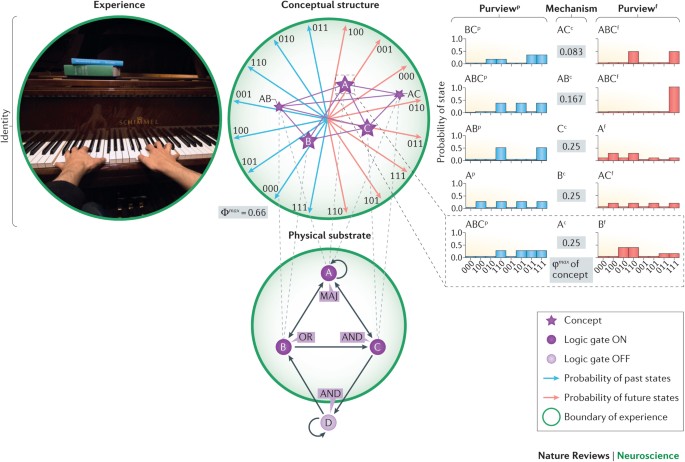
In this Opinion article, we discuss how integrated information theory accounts for several aspects of the relationship between consciousness and the brain. Integrated information theory starts from the essential properties of phenomenal experience, from which it derives the requirements for the physical substrate of consciousness. It argues that the physical substrate of consciousness must be a maximum of intrinsic cause–effect power and provides a means to determine, in principle, the quality and quantity of experience. The theory leads to some counterintuitive predictions and can be used to develop new tools for assessing consciousness in non-communicative patients.
Links
Related Papers
Companion
- Consciousness in the Universe: Neuroscience, Quantum Space-Time Geometry and Orch OR Theory — Penrose, Roger (2011)
- The CEMI Field Theory: Closing the Loop — McFadden, Johnjoe (2013)
- Can Panpsychism Become an Observational Science? — Matloff, Gregory L (2016)
- Weak Quantum Theory: Complementarity and Entanglement in Physics and Beyond — Atmanspacher, Harald (2002)
More in Methodology
Paranormal belief, conspiracy endorsement, and positive wellbeing: a network analysis
Planning Falsifiable Confirmatory Research
Addressing Researcher Fraud: Retrospective, Real-Time, and Preventive Strategies — Including Legal Points and Data Management That Prevents Fraud
Quantum Aspects of the Brain-Mind Relationship: A Hypothesis with Supporting Evidence
Paranormal beliefs and cognitive function: A systematic review and assessment of study quality across four decades of research
📋 Cite this paper
Tononi, Giulio, Boly, Melanie, Massimini, Marcello, Koch, Christof (2016). Integrated Information Theory: From Consciousness to Its Physical Substrate. Nature Reviews Neuroscience. https://doi.org/10.1038/nrn.2016.44
@article{tononi_2015_integrated_information,
  title = {Integrated Information Theory: From Consciousness to Its Physical Substrate},
  author = {Tononi, Giulio and Boly, Melanie and Massimini, Marcello and Koch, Christof},
  year = {2016},
  journal = {Nature Reviews Neuroscience},
  doi = {10.1038/nrn.2016.44},
}